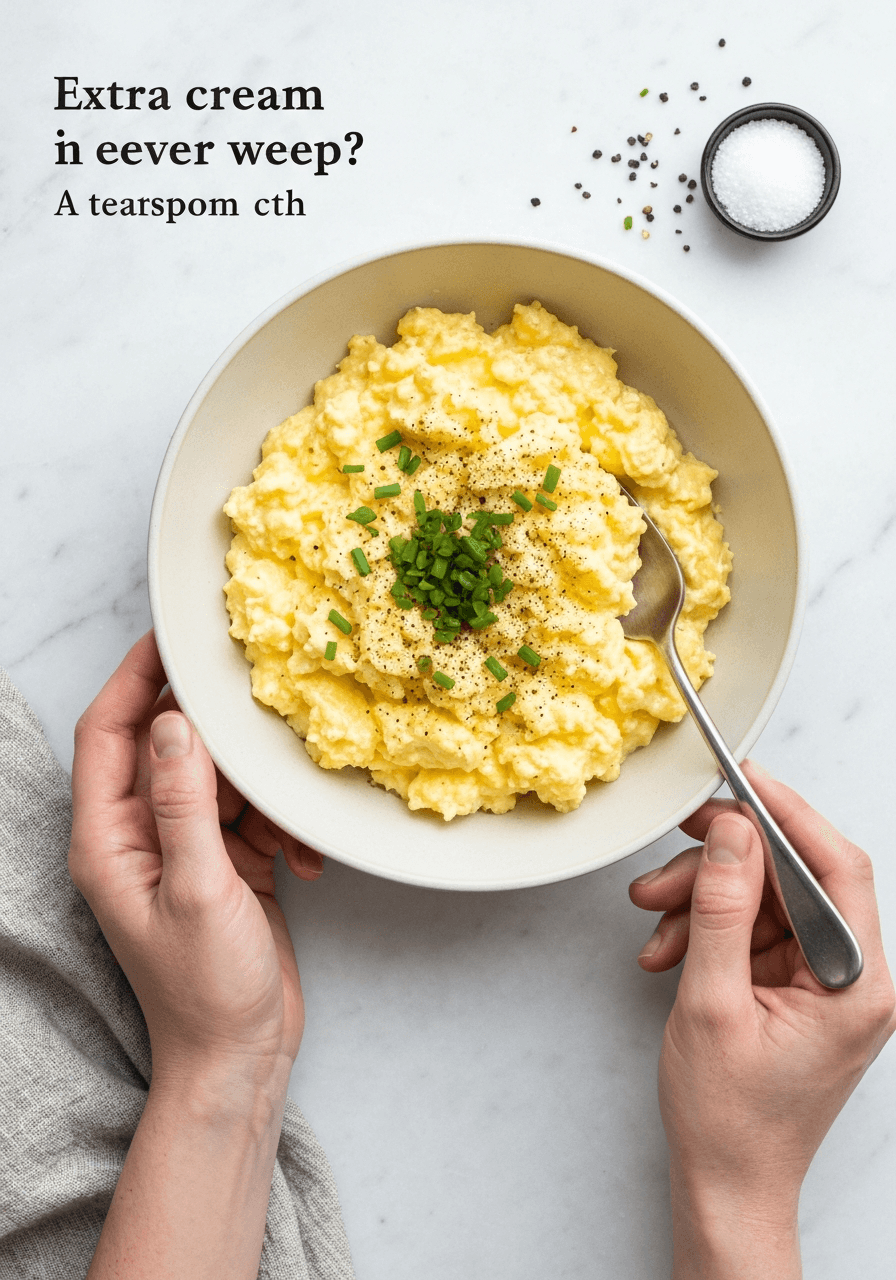
Extra-Creamy Scrambled Eggs
The secret to eggs that never weep? A teaspoon of cornstarch.
5 min total, perfect for busy mornings
Timing: 5 mins
Extra-Creamy Scrambled Eggs
The secret to eggs that never weep? A teaspoon of cornstarch.
5 min total, perfect for busy mornings
Timing: 5 mins
Key move
Scrambled eggs get rubbery because proteins bond too tightly, squeezing out water (syneresis). Cornstarch slurry inhibits protein bonds. You can cook these eggs hard, and they will still be creamy. It's foolproof.
Cook mode keeps your place
Larger text, ingredients in reach, and saved step progress while you cook.
The Setup
- Non-Stick Skillet8-10 inch·Essential for easy stirring and cleanup
- Silicone SpatulaFor constant stirring
The Mise en Place
5Your prep station before cooking begins
Seasoning (0/1)
The Eggs (0/1)
The Slurry (0/2)
The Fat (0/1)
Tastes chalky?
You used too much cornstarch or didn't whisk the slurry enough before adding the eggs.
Still rubbery?
You cooked them until dry. Pull them when they look wet and glossy—they finish cooking on the plate. If they look done in the pan, they're overcooked by the time you eat them.
Chef's Notes
The cornstarch is invisible when done right. If you can taste it, you used too much.
Pull the eggs from the heat when they still look slightly wet. They'll finish cooking on the plate.
Serve on buttered toast, with hot sauce, or topped with chives and smoked salmon.
The Method
WHISK
Prep aheadIn a bowl, whisk cornstarch (½ tsp) and milk (1 tbsp) until smooth with no lumps. Add eggs and salt (¼ tsp). Whisk vigorously until no streaks of white remain and the mixture is uniform yellow.
Cornstarch clumps: If cornstarch isn't fully dissolved in milk first, it will create gritty, gummy pockets in your eggs.
Mixture is uniform yellow with no lumps
FOAM
Time-sensitiveHeat a non-stick pan over medium heat. Add half the butter (about 1.5 tbsp). Wait until the butter melts and foams but doesn't brown.
Burnt butter: If the butter turns brown, it will impart a nutty, toasted flavor that clashes with the delicate egg custard.
Butter is foamy, pan is hot
STIR
Time-sensitivePour in the egg mixture. Immediately start stirring constantly and aggressively with a silicone spatula or wooden spoon. We aren't making curds; we are making a custard. Don't fold—swirl.
Over-coagulation: Stopping the agitation allows large, rubbery curds to form, ruining the intended velvet texture.
Eggs are forming soft, creamy curds
MOUNT
Time-sensitiveWhen eggs look wet but structured (like soft-set custard), remove from heat immediately. Stir in the remaining cold butter cubes off the heat. Continue stirring until butter melts and incorporates.
Carryover cooking: Leaving eggs in the pan too long results in dry, overcooked curds due to residual heat.
Eggs are glossy, creamy, and cohesive
SERVE
Plate immediately. The eggs will continue to cook from residual heat for about 30 seconds.
Carryover cooking: Do not leave eggs in the hot pan, or the residual heat will quickly turn the creamy texture rubbery.
Eggs are glossy and creamy on the plate
Appears in collections
Keep browsing by the kind of recipe choice this supports, not just this single dish.